
How do I set a marketing budget for my startup?

I have been getting this question often in recent months.  Founders have a business idea, have tested it and are ready to start marketing and selling it. How much should they spend on marketing? What size marketing and sales budget should be included in their financial model?

Here is a general approach:

  1. First lets define marketing & sales for a startup.  The marketing & sales budget should include ALL costs associated with acquiring and retaining customers and increasing revenue (or engagement) per customer.  Big companies can worry about the difference between sales and marketing and related organizational complexities.  For startups, it is all about acquiring and retaining initial customers.
  2. Now lets start at the end.  What are your near-term sales goals? What sales or traction milestone do you need to achieve to hit the next phase of your startup? So, for the purpose of this example, lets say that you need to hit $50,000 monthly revenue in 12 months.  And your average customer is worth $20 per month.  So, you need to be at 2500 customers in 12 months.
  3. Next, do some research on your business/market to understand some basic parameters, such as:
    • How long is the sales cycle, from beginning to first transaction?
    • What are benchmarks for the cost of acquiring a customer in your market?  There is a lot of public data available on this.
    • What are the different buckets of marketing costs that you need to consider? At minimum:
      • Lead generation – people, content marketing, SEO, ads, social, etc…
      • Sales process (from lead to close), including commissions
      • Retention/engagement, including customer service
  4. From there just do math to figure out the answer on the size of your initial marketing & sales budget.
  5. Finally , this is the important part – measure the results and make adjustments based on actual data.  Change the total budget.  Change the mix.  Figure out what works.  If something is working, double down on it.  Budgeting is a PROCESS.  

OK, I know what you are probably thinking.  Where do I get the magical data in Step 3?

Remember this is a PROCESS.  Start with something then adjust.  For many businesses here are rules of thumb to start with:

  • Sales cycle of 6 months.  Marketing dollars spent today will result in sales in 6 months.
  • Monthly Marketing & Sales cost = 6 x Monthly revenue of net new customers. So, if you need to add 400 customers at $20 per month in revenue, a first cut budget should be 6 x (400 x $20) = $48,000 per month.
  • Adjust to make sure this makes sense based the characteristic of your business.  The lifetime value of the customer should be 3.5x the cost to acquire and retain that customer.  In our example above, our cost of customer acquisition and retention is ($48,000/400) = $120.  Let’s assume the lifetime value of a customer is $20 per month x 36 months x 50% margin = $360 per customer.  So,  $360 / $120 = 3.0x.  That does not meet the target of 3.5x.  So, you need to make an adjustment somewhere.  For example, reduce initial marketing budget to $40,000 and start with than.  That’s Ok.  That is why this is a PROCESS.

So how do you breakdown the marketing dollars by programs? Here’s a starting point:

Year 1 – 80% lead gen/sales and 20% retention/engagement

Year 2 – 67% lead gen/sales and 33% retention/engagement

Year 3 – 50% lead gen/sales and 50% retention/engagement

If you have no other data, start with this and adjust.  The lean startup mantra of  Build – Measure – Learn is not just for developers.  It’s for marketers too!
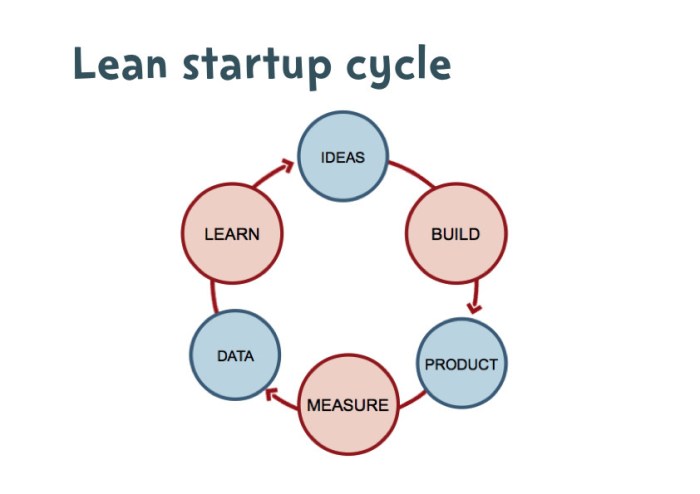
leanstartup-scaled1000

My Inbox Killed My Calendar

I hate being late or unprepared. No doubt the product of years of training in management consulting and Fortune 500 executive experience. Meetings should matter, and effective communication before, during and after makes a difference for desired outcomes.

Meeteor is an awesome new tool that does a great job of helping us make the actual meeting time more productive.

But what about actually scheduling the meeting?  That problem is getting worse, not better!

It should be easy. You need to meet with some people. You send a bunch of emails and messages to figure out a date, time and place that works for everyone. You put it in your digital calendar and start scheduling around the commitment. But too often it seems like something changes in the countless email string and I am the last person to know. Missing meetings or showing up at cancelled meetings has become a regular mistake.

Weren’t digital tools supposed to solve this problem?

I am a normal business guy with some interests in youth sports. I receive 250 non-spam emails a day in seven different email accounts, pushing my unread e-mail count North of 40,000 for the past six months. Unfortunately, that degree of clutter is typical these days.  Email is no longer good for scheduling.fullsizerender-49

Last year, I was hopeful that Slack would help remove this clutter problem. It’s a cool app for teams. But, for slack-125me, it has created more random clutter. Now, when people want to meet, I’m notified in both Slack and Mail.  Is this one meeting, or two? Who knows? It will change three times and I will probably miss it anyway.

Sound familiar?

It should not be that hard.  Our time is TOO IMPORTANT to be trapped inside of email or messaging apps.

New “bot” personal assistant apps have been launched recently to help this problem. But, these apps still live within the stream of existing communication platforms intended for another purpose. It’s no surprise that early adoption is an issue, since:

  • Only about 1/3 of emails are opened
  • The average elapsed time between an email send and open is 45 minutes.
  • Messaging apps like Slack provide more immediate response, but finding the relevant information in the endless message stream presents extra challenges

Even highly-funded bots require 8 emails to set up a meeting. They are simply automating and applying natural language processing to an outdated process. They solve the problem for one person, not the group. As soon as more than 2 people need to get together, the group ping-pong game starts. “Me” apps like these have limited value if you’re working with teams. “I will have my bot talk to your bot” doesn’t work.

Our time is TOO IMPORTANT.

Why can’t a simple app do all the work in one place, outside the cluster of e-mail or messaging apps? You tell the app who you want to meet with, and the app acts on behalf of everyone to find the best time and place to meet. This is the idea behind Skejul.

Before-Skejul-With-Skejul

Skejul moves life logistics into the 21st century and out of legacy email and enterprise systems.  We live in an always on, on-demand world, but our lives are about more than just work. We need to balance work, family and social activities. And we need a platform to bridge this gap.

We need a new platform to manage our most precious resource – TIME.

Does Lean mean Niche?

BHAG_Pic1

We are slowly working through some of the misperceptions of lean startup that are too common.  Lean does not mean short-term.  And, it does not mean cheap.  But does lean mean niche?

Well, you hear that a lot from start-up pitches, especially during demo day at accelerator graduations.  It usually goes like this:

“We started out solving big problem X in a big growing market,  then applied lean startup and pivoted to solving smaller problem Y in a niche market.”

Of course, no one actually says this until the cocktail party.  You have to read between the lines a little.  But, the general point is that “lean startup”  led them to pivot to a niche product/market fit.  

The repitition of this story creates a misperception that lean startup means niche**.

Lean is about learning, and you could just as easily learn that the problem you are solving is bigger, not smaller,  than initially thought.  Airbnb and Ubber did not niche down by applying lean principles.  In fact, they learned that the problem they were solving was ultimately larger than initially thought.  

One of the benefits of a fast Build-Measure-Learn cycle time should be that you can test bigger ideas more often.  So, it is not a given that end-product of Lean Startup will be a smaller opportunity.  Lean Startup is much more focused on managing downside risk and eliminating waste than reducing opportunity size.   I would argue that continuous application of lean principles is how start-ups can more efficiently navigate to much bigger market opportunities.

Despite this academic argument, I am still waiting to see a demo day presentation that explains how the application of lean startup tools opened founders’ eyes to a 10x opportunity. It would be great to have more examples to point to.  The simple reality is that there are a lot more small good ideas than big ones. 

(**Note –  This is nothing against niche opportunities.  My personal inclination is toward solving smaller, narrower problems instead of bigger, broader problems.)

Does Lean mean Cheap?

Frugal-Pig

Almost every startup now claims to be “lean”.  The funny thing is, when you start asking questions, the conversation usually turns to the following:

  • “Our developers work for practically nothing”
  • “We don’t get paid and work long hours”
  • “We are working out of coffee shops, our houses and low cost coop space”
  • “We spend very little on marketing”
  • “We share hotel rooms and fly Southwest”
  • “We are using offshore developers”
  • “We have accomplished a lot over the past X years with only Y funding”

These are not necessarily bad things.  In fact, being frugal in a startup situation makes  a lot of sense.  This frugality is in stark contrast to start-ups who “make it” to a big Round A/B and immediately rent out expensive office space and go on a hiring binge.  So, in many ways a cheap startup is better than old school dotcom spending.

But, this is not Lean.  This is Cheap — which sometimes makes sense, unless you do crappy work because you are not spending enough money.  No one wants to buy or invest in crappy work.

It reminds me of the manufacturing debate in the 1990’s — implement Lean Manufacturing versus moving jobs to Mexico/China. One had nothing to do with the other.  Most companies eventually learned that moving old manufacturing practices to low labor cost regions simply created more quality and logistics problems.  

Leans does not mean Cheap.

Here are the phrases that surround a Lean Startup approach:

  • Customer interaction
  • Experiment
  • Measure
  • Learn
  • Cycle time
  • Pivot

There is nothing in the Lean playbook that focuses on being cheap.  Its about a process and an investment in learning. 

Way too often, as startups get desperate for cash, they turn “cheap” by ignoring iteration, rapid deployment and learning in search of the hail Mary pass.  Somehow, they convince themselves that they do not have enough time or money to learn.

Lean is not about how much you spend.  It is about what you do and how you do it. 


Is Lean Startup Methodology Short-term Focused?

102091053-short-term-long-term.1910x1000

I have been hearing some discussion that Lean Startup methodologies are too short-term oriented.  The logic goes like this:

  • MVP’s (minimal viable products) are low quality, sloppy products
  • Too much focus on the process, not the big goal
  • It forces entrepreneurs to limit their vision
  • The process just asks customers what they want 

The conclusion reached is that Lean Startup is a fad or phase.

It is hard for me too be too critical of this thinking.  I actually remember thinking the same thing when I heard the buzz about six sigma and lean manufacturing in the 1990’s.  But, then I went through training and ended up leading projects.  I learned that Lean Manufacturing/6 sigma tools are part of a process and culture built around eliminating waste and continuous improvement.  That is not a fad or short-term oriented.  In fact, it is the exact opposite.  

Lean Startup is about learning in an entrepreneurial setting.  This learning allows you to manage risks and focus your limited resources more effectively and efficiently.  That is what entrepreneurial management is all about.  How can that possibly be short-term?  It is about sustained growth.

Lean Startup brings process and management discipline to the startup/innovation economy.   You cannot teleport from point A to point B.  You have to cover the space in between.  Lean Startup is about navigating that path, and sometimes changing your destination to point C.  

Focusing on the right things in the short-term enables the long term to happen.  That is not short-term thinking.  That is being humble enough to recognize that learning is important and can result in greater long term success  if you focus on process and management discipline, based on facts.  

A few weeks ago, I had the chance to have dinner with Lynda Applegate, who leads the Entrepreneurship program at HBS.  I was lucky enough to have been in her first technology class in 1987.   In her opinion, with the fast changing world that we live in, there is no difference between entrepreneurship and management.  They are now indistinguishable.  Bringing management discipline to entrepreneurship is not short term thinking.  It is simply entrepreneurship going mainstream, moving from Las Vegas to Main Street.


Why “2nd Tier” Startup Regions are Ripe for Lean Startup

flyovercountry

I hate the term “flyover country”.  But, during a recent week in Silicon Valley, I heard the term so much that I found myself using it.  Kind of like the term ecosystem.  

Flyover country has been a relative desert for the innovation and technologies driving changes across all parts of life.  There are a few “oases” out there, like Austin, Boulder and Chicago.  Further in (towards the middle), hard working visionaries are planting seeds and watering like crazy in places like Nashville, Dallas, Kansas City, Atlanta, Raleigh Durham and my home town of St. Louis.  

There is a lot going on in these “2nd tier” startup regions.  The leaders have taken a big risk and are working hard.   But, this activity is still  dwarfed with what is happening on the West Coast (Bay Area, Seattle, LA) and Northeast (Boston/NY/DC).   Price Waterhouse reports that 85% of venture capital is invested in these coastal regions, and only 15% invested in flyover country.

But there is something going on in coastal startup world.  Innovation creates change, change creates opportunities, and thus more innovation.  There is a disconnect in the market.   Too many good ideas and opportunities, but not enough skilled talent, management experience and business processes to execute.  Investors and leaders are shifting their focus from ideas, to people and processes.  

Lean Startup, with principles borrowed from lean manufacturing, has emerged to bridge this disconnect.  It is the buzz in Silicon Valley, where there is no shortage of ideas or money.  

There is not an idea shortage.  There is an execution shortage.

This is great news for flyover country! This creates opportunity for regional cultures steeped in the discipline and continuous improvement work of agriculture and manufacturing.  In fact, Lean Startup looks more like those industries than the large-scale software and hardware bets that fueled Silicon Valley for so long.   

Build-Measure-Learn is our regional competency.  Incrementalism is the Midwest mindset.  That’s why Missouri is the “Show-me” state.  My favorite quote from Chuck Knight, former Emerson CEO and famed leader, is “the long-term is but a series of short-terms”.  Lean Startup fits with our culture and can be at the core of the flyover country startup ecosystems (sadly, both terms in one sentence!).


The Age of Innovation

0001-106136322

Do you buy into the idea that we are entering the “age of innovation”?

A lot of fundamentals are in place:

  • It has never been easier to create new products and services
  • We can work more and more effectively in teams, without geographic limits
  • You can reach large audiences, on a global scale
  • Things are changing faster than ever, and change creates opportunity.

The list of tools that provide the supporting foundation are impressive:

  • High speed internet
  • Open source software
  • Mobile devices
  • 3D printing
  • Global communications
  • Foundational products/services — Google, Facebook, Twitter, LinkedIn

I am buying into it.  Sure, lots of things can get in the way.   And, there will be over-hype and snake oil salesmen  —  “The best of times, the worst of times”.  

But fundamentally, it has never been easier to identify a problem and start solving it.  And, with good execution, make the world a better place and/or earn money along the way.  This is true in all aspects of our lives– business (big, small and startup), non-profits, healthcare, governments, community service, etc … All parts of the economy.  

The only missing ingredients are people with the ideas, resources and skills to execute.  Those are the scarce ingredients around innovation.


What is lean marketing?

shutterstock_171707591

Content marketing is hot right now, and was a couple years ahead of Lean Startup in making the leap into the Fortune 500 market.  The Content Marketing World conference doubles in size every year in Cleveland.  Lots of really smart folks, all looking for unique angles on a very simple concept.  So much action, in fact, that the simple concept gets lost in all the noise.

Brian Clark and the team at CopyBlogger (now Rainmaker Digital) have consistently been at the cutting edge of thought and have provided the most powerful, simple messages in content marketing.  Their podcast network, called Rainmaker.fm, offers a whole series of podcast around content marketing topics.

The big messages from Rainmaker Digital are:

  • Create an Audience First, before you try to sell them something.
  • Be a resource for your audience.  They use the term Authority — where customers know, trust and believe you.
  • Media over Marketing

Digital media and the connected world makes this now possible.  This is one of the rare elements of “marketing” that connects with my engineering thought process.  It is 180 degrees from the Mad Men agency, advertising world.

A couple of weeks ago, I was in San Francisco with the Lean Startup Conference team and participated in a number of workshop sessions when it hit me.  The fundamental messages from Brian Clark and the Rainmaker Team are directly applicable to Lean Startup.  Start with the audience (customers), understand their problems and needs and then innovate and test ideas based on this.

This was not obvious to me until now.  The core fundamentals of Rainmaker’s digital content marketing and the principles of Lean Startup are a powerful combination.  This provides guidance to where startups need to focus their marketing resources — a form of “Lean Marketing” to complement “Lean Startup”.

A lot more thought on this is required.  But, the Rainmaker team and their friends are paving the road.

What’s a Business Model?

The first time I heard the term “business model” was in 1999.  I was in Philadelphia, meeting with Mark Walsh at VerticalNet.  At the time, VerticalNet had just gone public and was valued at $12 billion.  

VERTICAL NET 1-2Following the dot-com bust 3 years later, VerticalNet was dismantled and parts were sold of for less than $10 million.
In the HQ conference room, with $1 million+ of furnishings and artwork, and the first corporate wifi network I had seen (my Dell laptop didn’t even have wifi!),  the VerticalNet team explained all their different ideas for monetizing vertical market portals across first B2B and then consumer markets.   

All of these business models were very actively being pursued across 33 different vertical B2B markets (SEC filing):

  1. Two-sided marketplace => bringing buyers and sellers together
  2. e-Commerce => directly selling products snd fulfilling orders tailored for participants in a specific vertical market
  3. Media => eyeball driven advertising model based on best content for a specific content (basically online trade journals)
  4. PPC search => with online buyers guide and market specific search engine/keywords
  5. Community => professional network around a specific industry
  6. Career center with job placement
  7. Online education and industry courses for purchase

The VerticalNet team explained, with unbridled enthusiasm, all of the revenue model opportunities that were possible through a internet “portal” (remember that term?).  

The VerticalNet business model was  “all of the above”.

As we left the meeting, Mark Walsh pointed to his cell phone and said “You guys need to start paying attention to wireless and mobile”.  This was 1999.  

I was hooked on the buzz.  A month later I made a high risk pitch to Emerson’s executives that we should invest in the electronics portal of Vertical Net and start a new business around it.  Chuck Knight was CEO of Emerson, and at that time was on the board of IBM, Morgan Stanley, Baxtor Travenol and Anheuser-Busch.  I spent 10 minutes trying to explain to Chuck what an internet portal was. He didn’t “get it”.  It was a doomed idea.

Thankfully, the executives thought the idea had little merit.  And, a week later I turned down an opportunity to join the VerticalNet team — an offer that included a lot of stock options.  It was just too scary for me too.

All those good ideas were years ahead of their time.  But, they were all in one place, at one time, in the suburbs of Philadelphia.  

Reflecting on this after 15 years, I am struck with the following thoughts:

  • Ideas are a dime a dozen.  This is a really hard pill to swallow.  Ideas without execution have no value.  There were a lot of ideas in that conference room in 1999, and many of them were very good.
  • The lean startup approach/principles have pulled us out of the dark ages of startups. VerticalNet was as far away from a lean startup as possible.
  • We have come a long way in understanding web and tech business models.  We can point to so many successful examples now. VerticalNet was vertical marketing combination of FreeMarkets.com, LinkedIn, Lynda, Google and UpWork. This has made us all a lot smarter.
  • Being right about ideas is impressive, but ultimately meaningless unless customers are ready to participate.  There was no Build, Measure, Learn at VerticalNet.  It was more just build and sell.
  • Finally, “first to market” creates a lot higher risk than competitive advantage.  This happens over and over and over again.
  • The chasm between cool and business value is always lot wider than you think.

The Curse of Over-Valuation

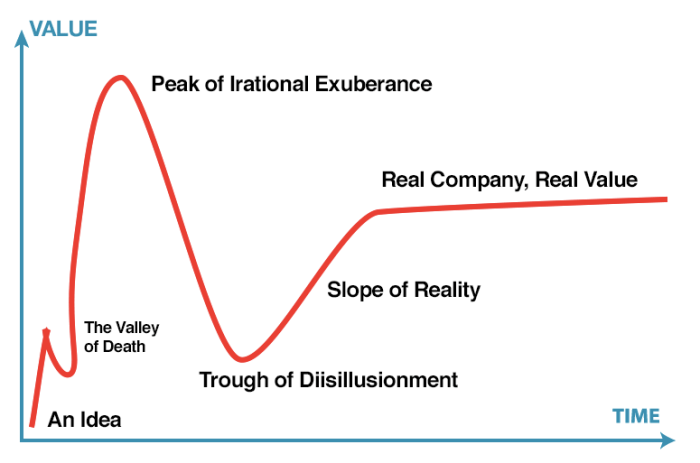
Startup-Hype-Cycle
Startup Hype Cycle – Michael “Luni” Libes

Most startups fight tooth and nail for every dollar of valuation investors give them.  That is a good thing, because I have come to believe that over-valuation is actually worse than under-valuation.  Here’s why:

Over-valuation happens when one or more of the following occurs:

  • Executives exaggerate the opportunity and/or under-represent the risks.  Note — these folks are a plague to startups. Cheerleaders do not play the game and do not belong at the table discussing value.  Cheerleaders have no true passion for the actual game, they have passion for cheering.
  • Investors do not take the time or lack the expertise to see through the hype.  I don’t buy the term “unsophisticated investor”, because these are typically not widows and orphans.  These are typically individual investors with more money than time or ones that enjoy high stakes gambling and are attracted to hype stories.
  • Personal relationships between founders and investors cloud rational thought and decisions.  This is the the classic friends and family investor class.  These investments are favors, not rational decisions.  My opinion is that companies should be required to disclose all investments from friend and family.

So, what’s the problem with over-valuation?  It’s a long list, but let’s start here:

  • It makes is harder to raise the next round of investment, because smart investors are highly skeptical of founder teams that hype valuation. It is amateur hour.  And this invariably happens exactly when the company’s survival is at stake.  
  • Even if the company has some success, over-valuation sets everyone up for a down round when institutional money comes in with a late seed round or a Round A. This perverts the natural progress of the company, creating a scenario where success feels like failure and where founders & early investors become their own worst enemy.
  • It creates tension at the board level, between founders, advisors and prior investors. Players take sides on the valuation question.  Here’s a tip, >90% of the time if a board member argues that the company is over-valued, he is right.  It takes courage and logic to swim against the current.  Joining in with the cheerleaders takes no effort or courage.
  • It can lead to a series of questionable”side deals” with future investors to justify the high valuation.  This usually takes the form of “we will use your services if you invest”, “we will give you exclusive sales rights in exchange for investment” or something along those lines.  Strategic relationships are great and important to startups. But, if the side deal is simply a way to prop up valuation, it is not sustainable.  The alternative is to completely separate the side deal from a mature, realistic negotiation on equity value.

My conclusion is that the problems arising from over-valuation are actually a lot worse than the challenges of under-valuation.  Hard work, discipline and smart management can fix a low valuation, whereas these same positive traits easily become the minority position in startups that are over-valued.

If you are in an over-valued situation, break the chains from the past.  There is no easy way out of this.  Down rounds should happen a lot more than they do.  Past valuation should not influence current decision making.  Mature executives and investors know that things always change and that pivots are usually needed.  

The process of successful innovation is more important than the intermediate scores.